Arduino Nano
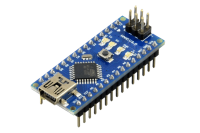
The Arduino Nano is an open-source breadboard-friendly microcontroller board based on the Microchip ATmega328P microcontroller (MCU)
and developed by Arduino.cc and initially released in 2008.
It offers the same connectivity and specs of the Arduino Uno board in a smaller form factor
The Arduino Nano is equipped with 30 male I/O headers, in a DIP-30-like configuration,
which can be programmed using the Arduino Software integrated development environment (IDE),
which is common to all Arduino boards and running both online and offline. The board can be powered through its USB Mini‑B receptacle or from a 9 V battery
Technical specifications
Microcontroller: Microchip ATmega328P[4]
Operating voltage: 5 volts
Input voltage: 5 to 20 volts
Digital I/O pins: 14 (6 optional PWM outputs)
Analog input pins: 8
DC per I/O pin: 40 mA
DC for 3.3 V pin: 50 mA
Flash memory: 32 KB, of which 2 KB is used by bootloader
SRAM: 2 KB
EEPROM: 1 KB
Clock speed: 16 MHz
Length: 45 mm
Width: 18 mm
Mass: 7 g
USB: Mini-USB Type-B [5]
ICSP Header: Yes
DC Power Jack: No
Communication:
The Arduino Nano has a number of facilities for communicating with a computer, another Arduino, or other microcontrollers. The ATmega328 provides UART TTL serial (5V) communication, which is available on digital pins 0 (RX) and 1 (TX).
An FTDI FT232RL on the board channels this serial communication over USB and the FTDI drivers (included with the Arduino firmware) provide a virtual com port to software on the computer. The Arduino software includes a serial monitor which allows simple textual data to be sent to and from the Arduino board. The RX and TX LEDs on the board flash when data is being transmitted via the FTDI chip and the USB connection to the computer (but not for serial communication on pins 0 and 1). A SoftwareSerial library allows for serial communication on any of the Nano's digital pins. The ATmega328 also supports I2C and SPI communication. The Arduino software includes the Wire library to simplify use of the I2C bus